
Paint Removal in Hackney
Safe removal of paint and coatings from brickwork, restoring the natural face of your brick without damage. Serving Hackney (E8) and the surrounding areas.
Free paint removal quote in Hackney
Send us the details and we will be straight back to you.
Heritage & conservation specialists
Lime-based restoration of period and listed buildings.
Structural brick stitching
Helical-bar repairs that strengthen cracked and bowing walls.
Trusted across London
Fully insured, working across the capital and home counties.
Masonry & brick paint removal across Hackney
Get the paint off without taking the brick with it
Painted brickwork is one of the most common things we are asked to reverse, and one of the easiest to get badly wrong. Done well, stripping paint off a Victorian or Georgian elevation transforms the building and lets the wall breathe again. Done badly, it takes the face off the brick and leaves you with a permanent problem instead of a painted one.
London Bricklayer remove masonry paint, limewash and coatings from brick and stone across Hackney and the surrounding area. We have been working on London's period and listed buildings since 1973, which means we are as interested in what is under the paint as in getting it off. Free survey, a trial area before we commit to an elevation, and an honest answer about whether removal is the right idea for your building.
The short answer
Can paint be removed from brickwork?
Yes, in most cases, and often very successfully. That is the short answer, and it is worth stating plainly because a lot of people have been told it cannot be done or that it will ruin the wall.
What determines how well it goes is a combination of four things: what kind of paint is on there, how many coats, what condition the brick underneath is in, and which removal method is used. Modern plastic masonry paints are more stubborn than older limewash or distemper. Half a dozen layers built up over decades take longer than one. A soft, previously blasted brick will tolerate far less than a hard, sound one.
The reason people hear that it cannot be done is usually that someone tried the wrong method, most often pressure washing or blasting, and damaged the brick. The paint almost always comes off. The question is whether the brick survives the process, and that comes down to method selection and testing rather than luck.
Straight answer
Should you remove it?
We remove paint for a living and we still tell some people not to. Here is how we think about it.
Removal is usually the right call when
- The building is a period property with good quality facing brick underneath. London stocks, gaults and Victorian reds were meant to be seen, and exposing them again generally improves the building enormously
- The paint is failing. Flaking, blistering and peeling paint looks worse than either bare brick or fresh paint, and repainting over failing paint just buys a few years
- You have damp problems that the paint may be contributing to. Modern impermeable coatings on a solid wall trap moisture, and removal is often part of the solution
- The building is listed or in a conservation area and the paint is an unsympathetic later addition. Conservation officers frequently welcome removal, though it will normally need consent
- You want to stop repainting. Bare, sound brickwork with good pointing needs no decoration. Painted brickwork needs redoing every several years, indefinitely
Think carefully when
- The brick was never meant to be seen. Some houses were built with cheap common brick on elevations always intended to be rendered, stuccoed or limewashed. There is no handsome facade waiting underneath, and stripping it exposes poor, irregular brickwork. This is more common than people expect, particularly on rear elevations and on some later Victorian speculative housing
- The paint went on to hide damaged brickwork. If a previous owner painted over widespread spalling, removal reveals the damage rather than solving it, and you are then committed to significant brick replacement
- The brickwork has been sandblasted in the past. Blasted brick has already lost its fired skin. It is soft, absorbent and much less able to withstand a removal process, and the result can be disappointing however carefully it is done
- The paint is historic in its own right. Original limewash, historic colour schemes and early painted finishes can be significant, and on a listed building removing them may be neither permitted nor desirable
- The budget only covers the stripping. Paint removal almost always reveals pointing that needs attention, and finishing the job properly costs more than the removal itself. Stripping and then leaving bare, open joints exposed is worse than leaving the paint on
Where removal is not the right answer, we will tell you, and we will talk you through the alternatives, which usually means either repainting properly in a breathable mineral paint or, on a genuinely poor elevation, considering a sympathetic lime render instead.
More than an aesthetic decision
Why painted brickwork causes problems
A solid brick wall has no cavity. It manages moisture by absorbing it and then releasing it again by evaporation through the brick and, principally, through the mortar joints. That cycle is how the wall stays sound. Modern acrylic and plastic masonry paints are considerably less permeable than the brick they cover, so they interrupt it. Water still gets into the wall, through cracks in the paint film, at junctions, around windows, from defective rainwater goods and by rising from the ground. Once in, it cannot get out at the rate it used to. The consequences show up in a predictable order:
- The paint blisters and peels, because moisture pressure builds behind the film. This is why painted brickwork so often looks poor within a few years of decoration
- Damp appears internally, sometimes for the first time, because moisture that used to leave through the outer face now travels inward instead
- Brick faces spall, as trapped moisture freezes and takes the surface of the brick with it, often invisibly under the paint until it is stripped
- Salts crystallise behind the film, pushing the paint off and damaging the brick beneath
There is a bleak irony worth knowing: a great many painted London houses were painted in the first place to solve a damp problem, on the theory that sealing the outside keeps water out. It does the opposite. If your house was painted for that reason, removal plus proper repointing and correcting the actual source of the water is very often the real fix.
Method chosen on evidence
How paint is removed from brickwork
There is no single method for every situation, and any contractor offering one without testing is guessing. What we use, roughly in order of how often, is set out here — and in practice most elevations need a combination, which is what the trial area establishes.
Poultice and gel systems
A thick alkaline or solvent based stripper is applied to the surface, sometimes covered with a laminate or fleece to keep it working, and left for hours or days depending on the product and the number of coats. It softens the paint through its full depth, which is then removed and the surface thoroughly rinsed and neutralised.
This is our usual approach on multiple layers of stubborn masonry paint. It is gentle on the brick because nothing abrades the surface, it deals with paint in the pores rather than just on top, and it can be adjusted in strength for the substrate. It is slower and more expensive than aggressive methods, and thorough neutralising and rinsing afterwards is essential, since residual alkaline stripper left in brickwork causes problems of its own.
Superheated low pressure steam
Professional systems deliver superheated water or steam at low pressure, using heat rather than force to lift coatings and soiling. Because the pressure is low, the brick surface is not abraded, and because it uses little water compared with jet washing, less moisture is driven into the wall. Systems of this type are widely used across the conservation sector and are frequently specified by conservation officers.
They work well on limewash, distemper, thinner coatings and general soiling, and they are often used in combination with a poultice on heavier paint: soften chemically, then remove with steam.
Softening and careful manual removal
On smaller areas, delicate detail and around features such as arches, mouldings and stonework, paint is softened and then removed by hand with non abrasive tools. Slow, and the right answer where machinery would damage detail.
Fine, controlled micro abrasive systems
Very low pressure systems using fine, soft media, used sparingly and only where gentler methods have failed and the substrate has been tested as able to take it. This is a long way from sandblasting in both pressure and media, but it still requires judgement and should never be the default.
What to avoid
Methods that damage brickwork in Hackney
These are the ones that create the permanent problems, and it is worth knowing them whether you are hiring someone or considering doing it yourself.
Sandblasting. The worst of them. Period bricks have a hard fired skin over a soft, porous core, and blasting removes that skin along with the paint. The wall then absorbs water like a sponge, spalls, and soils faster than it did before. It is irreversible, and a large part of the brick replacement work we do is on elevations blasted in the nineteen seventies and eighties. No reputable contractor will sandblast historic brickwork
High pressure jet washing. Drives water deep into the wall, erodes mortar joints, blasts out pointing and abrades brick faces. It also rarely removes modern masonry paint properly, so you get the damage without the result
Wire brushing, grinding and sanding discs. Abrades the brick face, scores the surface and leaves the wall looking scuffed. Particularly damaging on softer bricks and around arrises
Aggressive acids and unsuitable solvents. Can etch the brick, leave salts in the wall that cause efflorescence and spalling for years, and damage mortar joints. Chemical removal needs to be specified for the substrate and thoroughly neutralised, not simply bought on strength
Heat guns and open flame. Risk of scorching the brick, cracking it through thermal shock, and on older buildings a genuine fire risk where there are voids and timbers behind
Painting over failing paint. Not removal at all, but worth listing, because it is the most common response and it traps the problem for another few years
On vinegar and household remedies
There is a lot of advice online about removing paint from brick with vinegar, bicarbonate of soda, washing soda and similar. On a light smear of emulsion indoors, some of it may lift something. On coats of exterior masonry paint on a Victorian elevation, none of it works. Vinegar is a weak acid and its main effect on brickwork is to attack the mortar and, over repeated application, the brick surface. It will not shift a modern acrylic coating. Save the effort.
A straight assessment
Can I remove paint from my brick wall myself?
A straight assessment rather than a sales pitch, because plenty of people ask and the answer genuinely depends on the job.
Where it can be reasonable
A small interior area, a section of garage wall, a low garden wall, or somewhere the finish is not critical and the brick is modern and hard. Domestic strength strippers, patience and a lot of scrubbing will get you somewhere, and if it goes imperfectly the consequences are limited.
Where we would advise against it
A full elevation, anything above ground floor, anything on a period or listed building, and anything where the appearance matters. The reasons are practical rather than protective of our trade.
- The products that work are not sold retail. Effective poultice systems for multiple coats of masonry paint are trade products, applied at specified thicknesses and dwell times, and they need proper neutralising afterwards
- Consistency across an elevation is genuinely difficult. Patchy removal looks considerably worse than paint, and once part of a wall is stripped you are committed to finishing it
- Access. Anything above the ground floor needs scaffold, and stripping paint one-handed off a ladder is both ineffective and dangerous
- Waste and containment. Paint residue and stripper runoff has to be collected and disposed of properly, not washed into a drain or left on the garden
- Lead. Covered in the next section, and on an older building it is the single strongest argument against doing this yourself
- Mistakes are permanent. If you reach for a pressure washer or a wire brush out of frustration, which is what usually happens on day three, the brick damage cannot be undone
If you want to test the water, strip a small, discreet patch and see what you find. It will tell you what is under the paint and how hard it is going to be, and it costs you an afternoon. We are happy to look at photographs of what you uncover and tell you honestly whether it is a job worth continuing yourself.
Read this before you strip an old house
Lead paint removal: why stripping is the risky part
This matters and it is frequently overlooked. Paint on older buildings may contain lead, and lead based paints were in common use on British buildings for a long period before their use in domestic decoration was restricted. On a Victorian, Edwardian or interwar property there is a realistic chance that at least one of the layers on your walls contains it.
Lead paint is not dangerous while it is intact and undisturbed. Removing it is exactly the activity that makes it dangerous, because stripping, sanding, scraping and heating all release lead into dust, fumes and debris. That matters particularly where there are children or pregnant women in the household, and it matters for anyone doing the work.
What should happen:
- Test before you strip. Testing establishes whether lead is present rather than leaving it to chance, and it changes how the work must be carried out
- Choose methods that limit dust. Wet and chemical methods that keep material contained are preferable to dry abrasive or heat methods, which generate airborne lead
- Contain and collect. Sheeting, ground protection and collection of all residue, rather than letting debris fall into the garden, onto a pavement or into drains
- Protect occupants and neighbours, including keeping windows closed, restricting access to the working area and cleaning down thoroughly
- Dispose of waste correctly, as lead contaminated waste cannot go in a domestic bin or a general skip
- Use appropriate protective equipment, which for lead dust means considerably more than a dust mask from a merchant
We treat pre war buildings as potentially containing lead until testing says otherwise, and we work accordingly. Because the health and legal requirements around lead are specific and are the sort of thing that should be verified rather than assumed from a web page, we would encourage you to raise it directly at the survey so we can talk through what your particular building needs, and to seek advice from your local authority environmental health team or a suitably qualified specialist if you have concerns. If someone quotes to dry sand or blast paint off a Victorian house without mentioning lead at all, that tells you something about how they work.
Budget for the whole sequence
Paint removal is rarely a standalone job
Paint removal is very rarely a standalone job, and understanding that upfront prevents the most common disappointment on this kind of work. Paint has been protecting and concealing the wall, sometimes for decades. Once it comes off you see the brickwork as it actually is, and typically that means:
- Pointing that needs attention. Almost always. The mortar joints have not weathered while covered but they were often poor before painting, and paint removal exposes them. Repointing after stripping is the norm rather than the exception
- Some spalled or damaged bricks needing cutting out and replacing, particularly if the paint was hiding existing damage
- Previous repairs revealed, including cement patches, mismatched bricks and old cement pointing, which will need dealing with if the elevation is to look right
- Colour variation, since paint removal is rarely perfectly uniform in its effect on brick that has weathered differently across the wall. This settles as the wall weathers but is noticeable at first
- Ghosting, where traces of pigment remain in the pores of the most absorbent bricks. Usually faint and usually fades, but honest to mention
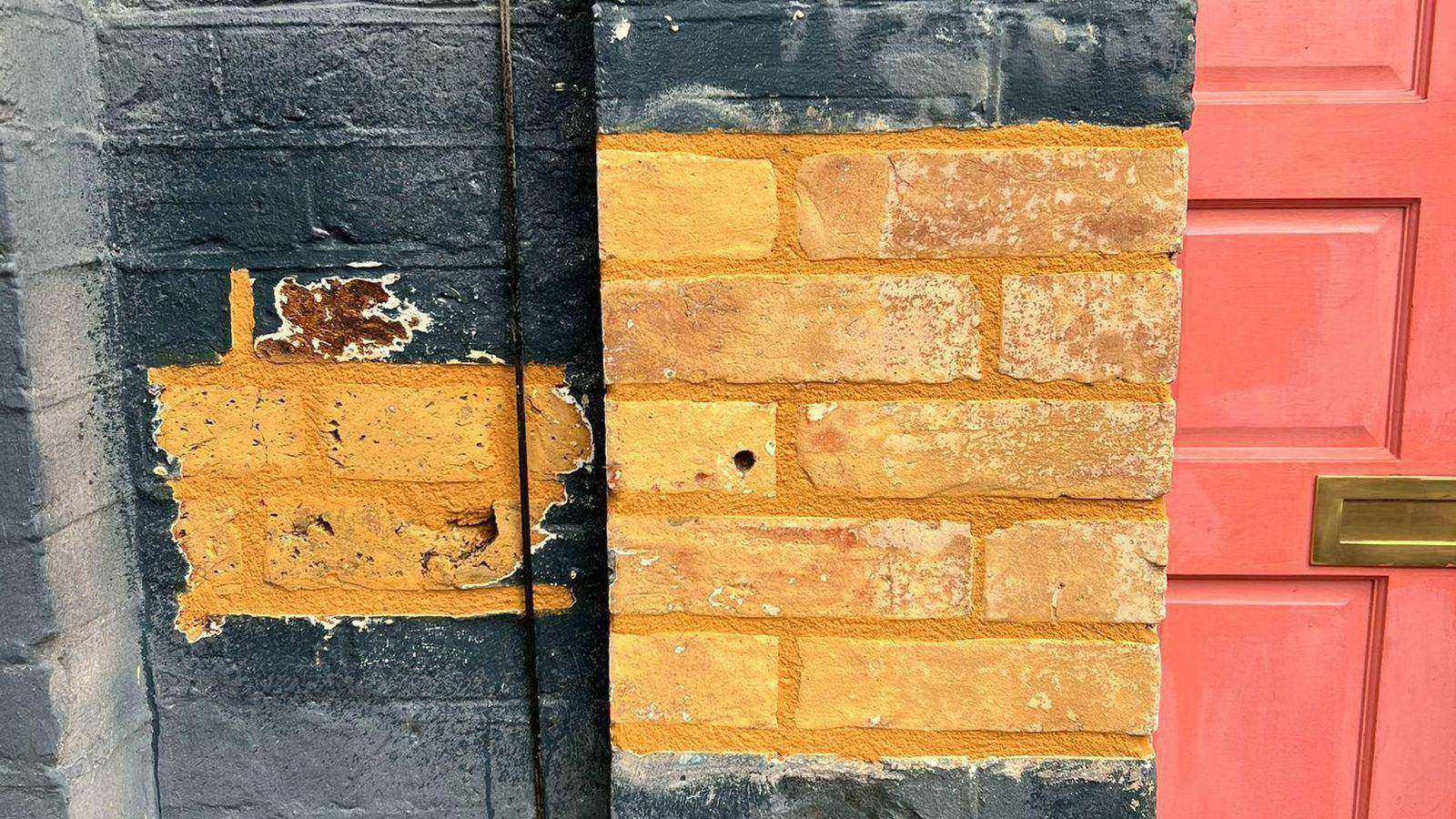
This is why we always open a trial area first. A square metre or two, stripped properly with the method we intend to use, tells you what condition the brickwork is in, how well the paint comes off, what the finished appearance will be and what making good will be needed. It converts a gamble into a decision, and it costs a fraction of the elevation.
Budget for the whole sequence rather than just the stripping. Removal, repointing and brick repairs done together under one scaffold is far more economical than coming back, and it is the only way to get a result you will be pleased with.
A different job indoors
Painted fireplaces and interior brickwork
Interior work is a different job from an elevation and worth treating separately. Painted brick fireplaces, chimney breasts and exposed internal walls come up regularly, usually where a previous owner painted over brick that the current owner would rather see. The practical differences indoors:
- Containment matters more. You are generating dust and chemical residue inside a room people live in, so sheeting, ventilation, floor protection and a proper clean down are a significant part of the work
- Methods are more constrained. Steam and water based systems are harder to use indoors, so poultice and gel systems with careful manual removal tend to be the practical approach
- Lead is at least as likely. Interior paint on an older property may well contain lead, and doing this in a living space makes containment more important rather than less
- The brick may not be facing quality. Internal brickwork, and the brickwork inside a fireplace opening in particular, was often never intended to be seen and can be rough, irregular or built in a mixture of bricks. Worth a trial patch before committing to the whole chimney breast
- Soot and fire damage inside an opening is a separate issue from the paint and may need addressing too
Send us photographs and we will tell you what you are likely to find and whether it is worth doing.
Gentler and slower
Removing paint from stone
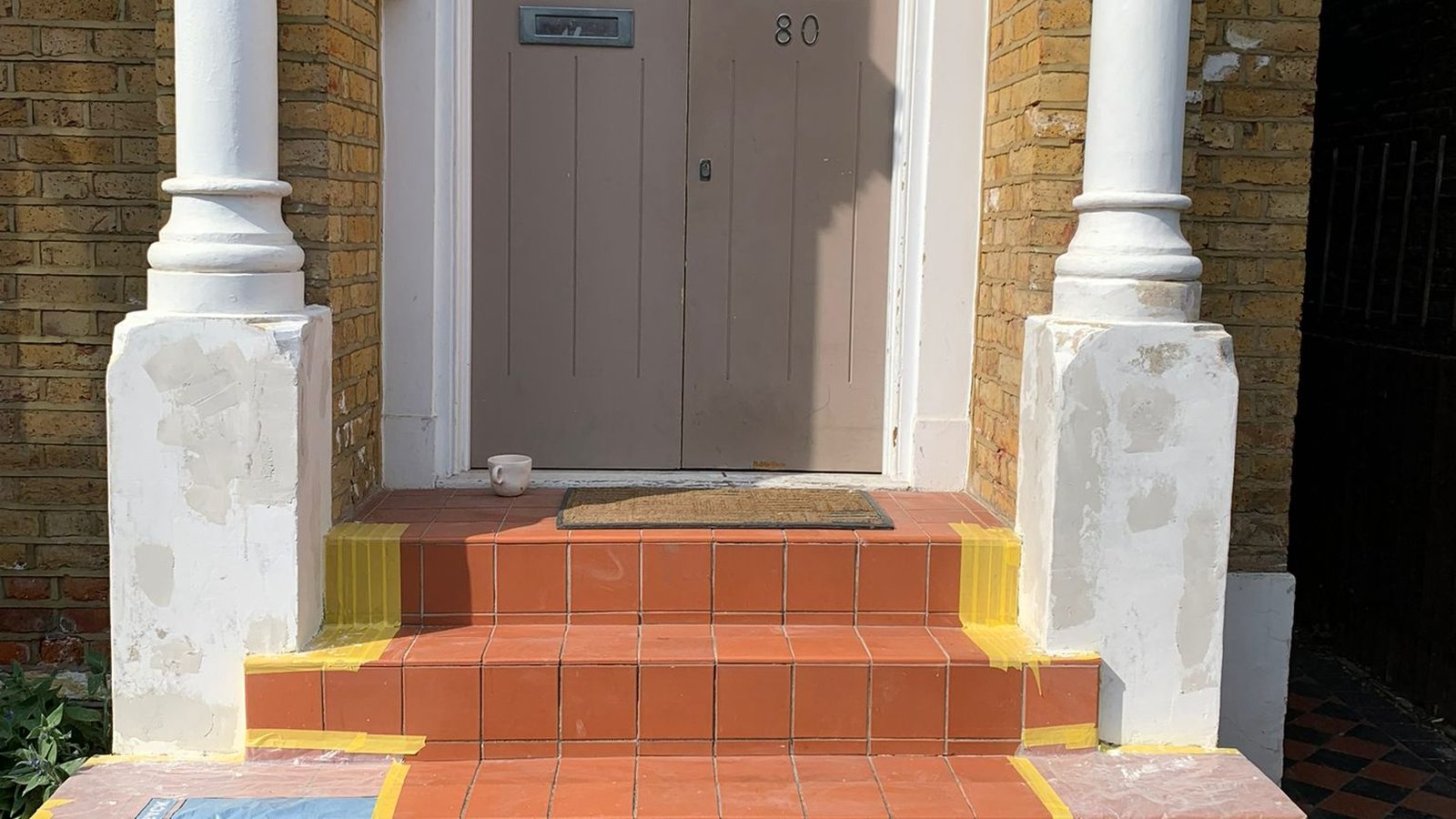
Many London elevations combine brick with stone cills, copings, string courses, steps, lintels and door surrounds, and when a house was painted the stone usually got painted with it.
Stone needs more caution than brick. It varies enormously in hardness and porosity, from relatively robust Portland through to soft, fine grained stones that mark easily, and some are sensitive to particular chemicals. Carved and moulded detail is also intrinsically more vulnerable, since any abrasion softens the profile permanently and you cannot recover a crisp arris once it is rounded off.
Our approach on stone is gentler and slower: appropriate poultice systems tested on a discreet area, low pressure steam where suitable, and hand work around detail. Where a stone is genuinely too soft or too degraded to strip safely, we will tell you and discuss the alternatives rather than press on and damage it.
Transparent pricing
What affects the cost of paint removal
Paint removal is priced from a survey and, ideally, from a trial area, because two elevations of the same size can differ by a factor of several depending on what is on them. The variables:
- Area and how many elevations are in scope
- Number of coats. Frequently the biggest single factor. One coat of limewash and six coats of accumulated masonry paint are entirely different jobs
- Type of paint. Modern acrylic and plastic coatings are considerably harder to remove than older limewash, distemper or oil based paints
- Method required, since poultice systems with long dwell times and multiple applications cost more than a single pass of anything
- Substrate condition and sensitivity, as soft, previously blasted or degraded brickwork needs gentler and therefore slower treatment
- Access. Usually a major line. Height, scaffold duration, street constraints, pavement licences and access over neighbouring land
- Detail and features. Arches, mouldings, corbelling and stonework all need hand work rather than broad treatment
- Lead. Testing, containment, controlled methods, protective equipment and specialist waste disposal all add cost, and they are not optional where lead is present
- Containment and protection generally, including sheeting, ground protection, collection of residue and protecting windows, planting and paths
- Neutralising and rinsing, which on chemical removal is essential and takes time
- Making good afterwards, meaning the repointing and brick repairs that removal almost always reveals. Priced separately so you can see it clearly
- Listed building requirements, including specified methods, trial panels for approval and recording
Our quotes are itemised and state the method, the number of applications assumed, the access and what making good is included, so you can compare properly. On this work in particular, a much cheaper quote almost always means a faster and more abrasive method, and the saving is dwarfed by the cost of replacing brick faces afterwards.
Step by step
Our Paint Removal process in Hackney
Survey
We look at the paint, the substrate, the exposure and the detail, assess the likely number and type of coats, check for evidence of previous blasting or damage, and discuss the age of the building in relation to lead.
Trial area
A small area stripped with the proposed method so you can see what comes off, what is underneath and what the finished appearance will be. On listed work this is also the sample for approval.
Method and specification
Method selected on the basis of the trial rather than assumption, with the products, dwell times, neutralising and making good all set out in writing.
Testing where required
Including lead testing, so the working method and containment reflect what is actually present.
Consents
We tell you what we believe requires listed building or conservation consent and support your application with technical detail.
Access and protection
Scaffold as required, with sheeting, ground protection and protection to windows, stone, paths and planting, and containment appropriate to the method and the waste.
Removal
Applied, worked and repeated as the paint requires, then thoroughly rinsed and neutralised.
Assessment of what is revealed
We walk the stripped elevation with you and agree the making good before proceeding to it, so nothing is a surprise.
Making good
Repointing in a matched mortar and brick or stone repairs as required, under the same access.
Clean down and handover
Waste removed and disposed of correctly, site cleaned, and the completed work walked with you.
Why London Bricklayer
Paint off, brick intact, done once
- Working on London's period and listed brickwork since 1973, including work to conservation officer specifications
- Trial area before every elevation, so the method is chosen on evidence and you see the result before committing
- We never sandblast historic brickwork and do not use high pressure washing on it
- Honest about whether removal is right, including telling you when the brick underneath was never meant to be seen
- Lead treated seriously on older buildings, with testing and appropriate containment rather than assumption
- Repointing and brick repair in house, so the making good that removal reveals is dealt with under the same scaffold by the same people
- Brick and stone both, with the gentler approach that stonework and carved detail require
- Fully insured, with public liability cover and safe working on every project
- Covering Hackney, the wider capital and the home counties
Paint Removal in Hackney: Your Questions Answered
Everything you need to know about paint removal in Hackney. Still not sure? Just ask.
Will removing the paint damage our brickwork?
How long does paint removal take?
Will all the paint come off?
What will the brickwork look like underneath?
Will we need to repoint afterwards?
Is there lead in our paint?
Can we just paint over it again instead?
Do we need consent to remove paint?
Can you remove graffiti or spray paint?
Do you strip painted interior brickwork and fireplaces?
What about the paint on our stone cills and door surround?
Can we do part of the house now and the rest later?
What happens to the waste?
Other brickwork services in Hackney
We provide a whole range of brickwork services for our Hackney clients:
Looking for paint removal in a nearby area?
We also cover surrounding areas across London and the home counties:
Covering Hackney
We work throughout Hackney (E8) and the surrounding London areas. Get in touch to check we cover your street, we almost certainly do.
Arrange a free paint removal survey
If you have a painted period property and you are wondering what is underneath, the survey and a trial area are the only way to find out properly. We will tell you what is on the wall, what is likely to be beneath it, whether removal is the right idea and what the whole job realistically involves. Working across Hackney, the wider capital and the home counties. Fully insured. Working on London’s period brickwork since 1973.